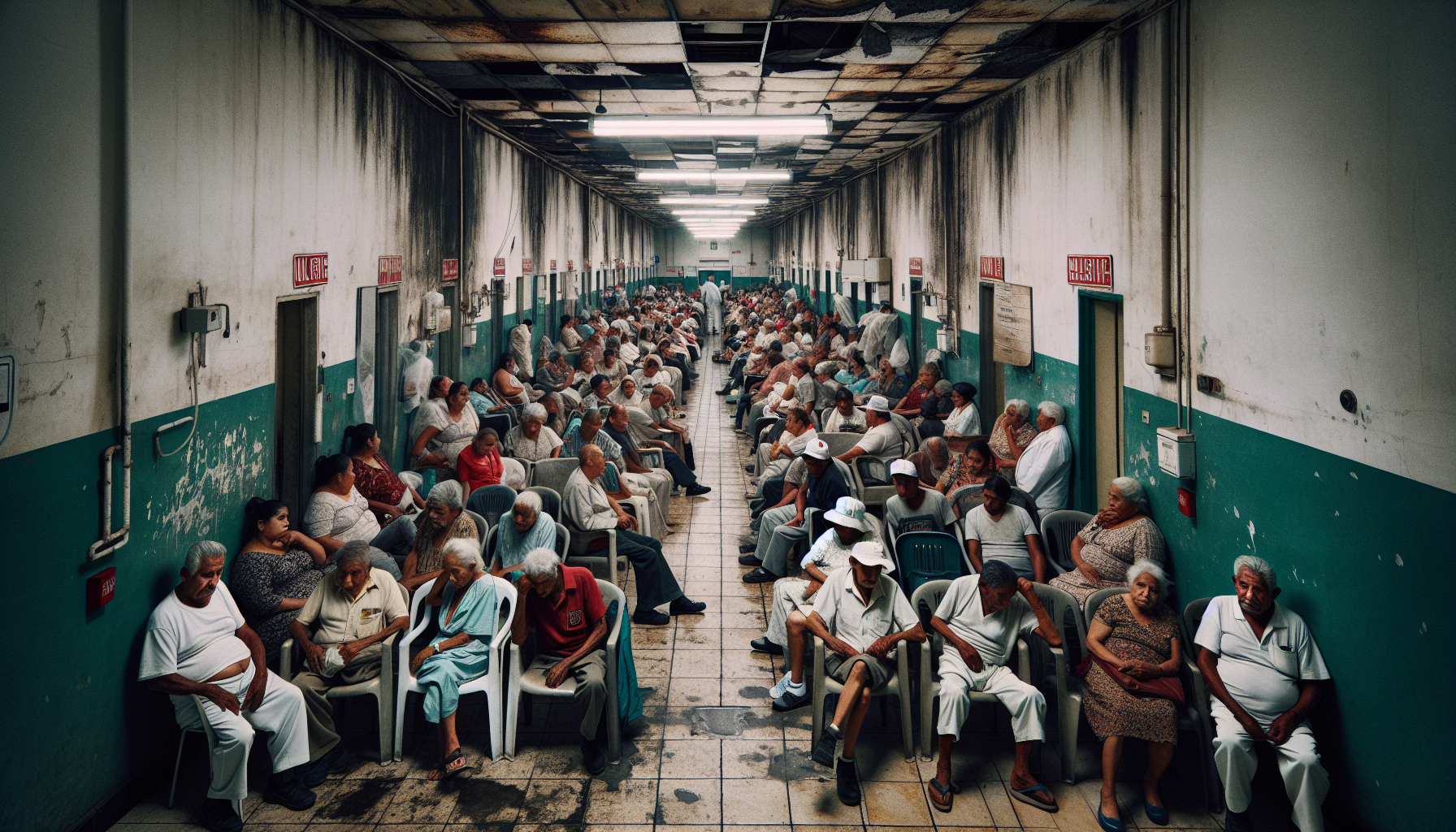
I write a lot about Mexico. Some of it is praise. A lot of it is not. I spent an entire post cataloguing what a mess the IMSS system is, how people die from treatable conditions, how the pharmacy doctor gives everyone an antibiotic shot regardless of what’s actually wrong with them, how the whole thing is structurally underfunded and has been restructured four times in seven years without ever getting better.
So when I tell you Mexico is doing something right, I mean it.
New York City Mayor Zohran Mamdani announced plans to open five city-owned grocery stores, one per borough, on city-owned land, operating without a profit motive. The first site is La Marqueta in East Harlem, opening by 2027. The goal is to undercut private retail on staples. Eggs cheaper. Bread cheaper. Basic food at prices the people who actually live in East Harlem can afford.
The reaction from the American right was immediate and predictable.
“At our stores, eggs will be cheaper. Bread will be cheaper. I look forward to the competition. May the most affordable grocery store win.”
Donald Trump called him a “100% Communist Lunatic.” 1 Rep. Elise Stefanik, who has built her entire gubernatorial campaign around mocking Mamdani, called the plan evidence of a “Communist takeover” and went on Mark Levin’s show to say the word “commie” enough times to fill a drinking game. 2 RedState ran a headline about the ghosts of Soviet Union leaders grinning. 3 Gristedes owner John Catsimatidis threatened to close his stores and called it a “Soviet-style disaster-in-waiting.” 4
The communism charge is funny given that the United States military has operated government grocery stores since 1867 and nobody calls the DoD a Marxist institution. 5 But more to the point: Mexico has been running a network of state-owned food stores for over sixty years, and I live here, and I can tell you what they actually look like.
They look like a store.
What Mexico Built, and Why
Mexico’s current government food system is called Alimentación para el Bienestar. It was formalized in January 2025 when President Claudia Sheinbaum merged two older agencies, Segalmex and Diconsa, into a single entity under the Agriculture ministry. 6 The name translates roughly to “Food for Wellbeing,” and the network it runs is bigger than most Americans realize.
As of mid-2025: 7
- 25,164 Tiendas del Bienestar operating nationally
- 66 million people served monthly
- 2,234 municipalities covered, over 90% of the country
- Average 20% savings on the basic basket compared to private supermarkets
- Staple prices: maize at 6 pesos per kilogram, beans at 35 pesos per kilogram
For context on that 20% figure: the basic food basket at a Tienda del Bienestar runs around 450 pesos. 8 At Walmart Mexico or Soriana, the same basket runs 693 to 1,008 pesos depending on the region, per PROFECO’s weekly pricing surveys. 9 That gap is not nothing. For a family spending a third of their income on food, that gap is rent money.
The network also runs Liconsa, the state dairy program, which sells fortified milk at 6.50 to 7.50 pesos per liter nationally versus roughly 25 pesos per liter for private brands. 10 It operates 12,616 distribution points across 88% of Mexican municipalities. There are also now Productos del Bienestar branded goods: Café Bienestar, sourced from 6,646 small producers in Oaxaca, Puebla, Veracruz, and Guerrero, retailing at 65 pesos for a 90-gram jar of pure instant coffee with no fillers, versus comparable Nescafé products at roughly 90-110 pesos. 11 Chocolate Bienestar, sourced from indigenous cacao producers in Tabasco and Chiapas, retails at 14 pesos for a 20g bar. 12
This is not a fringe welfare program. It is infrastructure.
| Product | Tienda del Bienestar | Walmart / Soriana | Savings |
|---|---|---|---|
| White maize (1kg) | 6 pesos | 14–18 pesos | ~60% |
| Black beans (1kg) | 35 pesos | 45–60 pesos | ~30% |
| Liconsa milk (1L) | 6.50–7.50 pesos | ~25 pesos | ~70% |
| Café Bienestar (90g jar) | 65 pesos | 90–110 pesos (Nescafé equiv.) | ~30–40% |
| Full basic basket | ~450 pesos | 693–1,008 pesos | ~20–55% |
This Is Not a New Idea Anywhere
The “government competing in food retail is communism” argument collapses the moment you look at history.
The U.S. military commissary system has operated since 1867. There are 235 stores today serving 8.3 million authorized households, with a federal appropriation of roughly $1.7 billion annually. They advertise “at least 25% savings” compared to commercial grocery. 5 Nobody calls this Soviet.
During World War II, the UK’s Ministry of Food under Lord Woolton ran a virtual monopoly on food distribution for the entire country, including 2,000 British Restaurants and school meals for 650,000 children. 13 The US Office of Price Administration froze prices on 90% of retail food items. 14 Both are remembered as effective policy.
Switzerland’s Migros, founded in 1925 by Gottlieb Duttweiler on the explicit thesis that cutting out middlemen could undercut private retailers by 20-30%, converted to a cooperative in 1941 and became the country’s largest retailer. 15 TIME magazine wrote in 1955 that it had “revolutionized” Swiss retail by forcing prices down across the entire sector.
Mexico’s own predecessor, CONASUPO, ran from 1962 to 1999 and at its peak was purchasing over 80% of Mexico’s maize imports and guaranteeing prices on 11 crops. When NAFTA pressures and corruption killed it in 1999, tortilla prices rose roughly 738% over the following decade. 16 ADM, Cargill, and Maseca filled the vacuum. So much for the free market looking out for the tortilla-eating poor.
The academic evidence supports the competitive-discipline argument. A USDA study found Diconsa stores selling staples 19% lower than private retail in rural areas and 13% lower in urban areas. 17 An NBER working paper by Cunha, De Giorgi, and Salvadori found that Bienestar-style in-kind food transfers actively lowered prices at private non-government stores in the same areas, not just at the government stores. 18 When the government shows up to compete, private retailers cut prices. That’s the whole mechanism. It works at scale.
The Honest Part: It’s Not Perfect
I’ve been giving Mexico credit it deserves. Here’s the part where I earn it back.
The predecessor agency, Segalmex, was looted. Between 2019 and 2022, auditors found irregularities of up to 15 billion pesos — roughly $850 million USD. Contracts for pesticides and grain storage materials went to shell companies that never delivered anything. Twenty-six people were arrested. The former head, an AMLO loyalist, is accused of siphoning 8.63 billion pesos in a single year. AMLO himself called it “a stain” on his government, which is quite the understatement. 20
The merger into Alimentación para el Bienestar was supposed to fix this. By August 2025, investigative journalists at MCCI found that the new agency had already assigned 2 billion pesos in contracts to five new shell companies, one of which listed a sick, unemployed woman as majority shareholder. 21 Different name, same behavior.
So: the stores work. The prices are real. The savings are real. The scale is real. The corruption is also real, persistent, and has not been solved by renaming the agency. Mexico’s food sovereignty program is a genuine public good sitting inside a procurement system that keeps getting robbed.
Mamdani is inheriting a cleaner institutional environment but a much harder political one. The US doesn’t have Mexico’s history of state food infrastructure to build on. And five stores is genuinely not enough to move the needle on a city of 8 million people in a $115 billion grocery market. Even Mamdani’s own supporters — including a former Whole Foods VP who publicly backs the plan — have noted that you need at least 20 locations running an Aldi-style limited-SKU model to achieve the wholesale buying power that generates real savings. 22 Five is a proof of concept. It’s a start.
That said: Kansas City put $18 million into a single subsidized grocery store in a food desert in 2019. It closed in August 2025 after customer counts fell from 14,000 to 2,000. 23 The critics pointing to that failure are not wrong. The difference is that Kansas City was trying to make a marginal private store viable in a market that couldn’t support one. Mamdani is trying to create a permanent public competitor that doesn’t need to be viable on private terms. Those are different bets.
What Walmart Thinks About All This
Here is the part the right-wing commentators skip.
In Mexico, Walmart responded to the Bienestar network not by going to war with it but by signing a government price-cap agreement. The November 2025 PACIC renewal brought Walmart, Soriana, Chedraui, HEB, and a dozen other retailers to the table, agreeing to cap a 24-product basic basket at 910 pesos for six months. 24 This is the competitive-discipline effect in action. The government shows up as a market participant, and private retailers either compete on price or lose customers.
Walmart also announced a $6 billion investment in Mexico in April 2025, at Sheinbaum’s own press conference. 25 They are not fleeing. They are adapting.
In New York, Gristedes owner John Catsimatidis threatened to close stores and flee. The National Supermarket Association said five government stores was “a big slap in the face.” 4 The math here is telling. Mexico has 25,000 government stores and Walmart just committed $6 billion to stay. New York is proposing five stores and the private sector is calling it the end of civilization.
| Country | Government program | Private sector response |
|---|---|---|
| Mexico | 25,164 Tiendas del Bienestar | Walmart signs PACIC price caps; invests $6B; competes on price [24] [25] |
| United States (NYC) | 5 stores proposed | Gristedes threatens to close; trade groups call it Soviet; congressman calls it Marxist [4] |
What the Critics Are Actually Afraid Of
The Soviet Union rhetoric is not a genuine policy argument. It’s a tell.
When government enters a market and offers a product cheaper, private companies have two choices: compete on price, or lose customers. What they cannot do is maintain margins they’ve been taking for granted. That’s the threat. Not bread lines. Not collectivization. Slightly lower profit margins on eggs.
The Bienestar network in Mexico doesn’t just serve 66 million people at discounted prices. It keeps Walmart honest in markets where Walmart would otherwise be the only option. That is how competitive markets are supposed to work. The government isn’t replacing the private sector; it’s disciplining it.
The downside? Soriana and Walmart lose money on staples at stores near Bienestar locations. Kroger and Walmart in the US would face the same pressure if Mamdani’s plan ever scales to actual size. Both those companies will survive. I’m sure Americans and Mexicans alike are going to lose a lot of sleep worrying about Walmart’s margins.
Sources
Share on
Bluesky Twitter Facebook LinkedInComments are configured with provider: disqus, but are disabled in non-production environments.