
You’ve done your homework. You checked the INM website three times. You have your passport. Your residency card. Your CURP printout. Copies of everything. The formato básico, printed and signed. A proof-of-address bill with your name on it.
You sit in the waiting room for 90 minutes. You get called up. The officer looks at your stack and tells you: the copy of your passport needs to be front page AND the page with the entry stamp, on separate sheets, not both on one page.
Come back Thursday.
Welcome to the trámite experience in Mexico. It’s not random. It’s not just laziness, though that’s part of it. There’s a structural reason every transaction requires what feels like a notarized copy of your first communion certificate. Once you understand it, the whole infuriating system starts to make a different kind of sense.
The Short Answer: Mexico Is a Low-Trust Society
Here’s the concept that explains almost everything about dealing with Mexican bureaucracy.
In high-trust societies, systems are built on the assumption that most people are telling the truth most of the time. You say you live at a certain address, they believe you. You sign a form, that signature carries real weight. The friction is low because trust is the default.
In low-trust societies, the opposite is true. No one assumes you’re telling the truth. Every claim you make has to be verified, documented, and certified. The friction is high by design, because the system assumes it will be gamed.
Mexico qualifies as a low-trust society by essentially every measure researchers use.
The research
A 2018 paper published in Public Administration and Development by researchers at CIDE (Mexico's Centre for Research and Teaching in Economics) coined the term "low-trust bureaucracy" specifically to describe Mexico's administrative system. They found that only 12% of the Mexican population had faith in others according to 2014 OECD data, compared with much higher figures in Nordic countries and Germany. The paper argued that excessive documentation requirements are not a failure of the bureaucratic design — they are the design, built to manage a system where neither citizens nor bureaucrats trust each other. The result: "administrative exclusion" that disproportionately harms low-income people who can't navigate the requirements, while well-connected people with fixers sail through.
Source: Peeters, R. et al. (2018). Low-trust bureaucracy: Understanding the Mexican bureaucratic experience. Public Administration and Development.
The paper documentation requirements aren’t bureaucratic incompetence. They’re the system working as intended: demanding proof for everything because the default assumption is that citizens will lie if given the chance. When every claim requires a certified document, the stack of papers gets tall fast.
This shows up everywhere. INM. SAT. The bank. Telcel. Opening a business. All of it.
Why the Line Doesn’t Move
The documentation requirement is one half of the experience. The other half is the speed — or the spectacular lack of it.
Here’s what’s actually going on. A low-level INM officer has been handed enormous power over your life. They can reject your application. They can send you home. They can decide that your utility bill doesn’t count because the name is slightly different from what’s on your residency card. That discretion is real power, and for someone who doesn’t have much of it anywhere else, it feels good to use it.
The research on discretionary power
The CIDE research describes this as "street-level bureaucracy" in a weak institutional context. Frontline officials in low-trust systems are given wide discretionary authority, which they use inconsistently — sometimes as simple power expression, sometimes in exchange for informal compensation. A 2023 follow-up paper in Public Administration on street-level bureaucracy in weak state institutions found that these officials use process ambiguity to extract deference from citizens, not because they're uniquely corrupt, but because the institutional incentives push that direction. The lack of enforceable, standardized procedures means the officer at the window genuinely has the last word.
There’s also a simpler force. If you only need to process two people per hour to avoid any consequences, you process two people per hour. No reward for efficiency. No penalty for slowness. A waiting room full of people with no leverage.
I got a front-row seat to both of these forces in December 2025 when I went to convert from temporary to permanent residency. I arrived an hour early. On purpose. I wanted the officers to review my documents before my appointment so nothing would be missing. They did. Everything looked fine.
My appointment came. They found one more paper they needed. We could have walked across the street, printed it, and been back in 15 minutes. They sent us home anyway. Come back tomorrow. No appointment — which means arriving at 7am to get in line before the office opens.
There was no reason to make us come back the next day except that the officer could. She had the power, she used it, and that was the end of the conversation. A low-level bureaucrat who is probably unhappy with her personal life, with a waiting room full of people who have significantly more economic standing than she’ll ever have. She had exactly one thing they didn’t: discretion over their time.
I rolled my eyes. Out loud. Involuntary reaction. She saw it. My ex-husband was acting as my translator and he gave me a look I understood clearly: stop.
More on that in a minute.
The Paper Stack Is Also a Revenue Stream
There’s a third force making the process complicated, and it’s deliberate.
When a process is so time-consuming, tedious, and opaque that a meaningful percentage of people will pay to avoid it, a market opens up. Mexico has an entire industry of gestores and tramitadores — professional fixers who know the system, know the officers, and can get your paperwork processed while you stay home. They charge real money for this.
Some of it is legitimate navigation. Some of it is mordida — the bribe.
Mordida by the numbers
Mexico ranked 141st out of 182 countries in Transparency International's 2025 Corruption Perceptions Index, scoring 27 out of 100 — its worst result in recent history and last among OECD members. Transparencia Mexicana documented that Mexican households paid bribes in more than 10 out of every 100 interactions with public procedures and services, representing over 200 million irregular transactions and a cost exceeding 32 billion pesos. INEGI estimates that bribes were paid more than 18,500 times per day at the peak of measured activity, with Tijuana specifically identified as one of the highest-frequency cities. Individual mordidas are typically small (50–200 pesos), but the aggregate is enormous.
Sources: Transparency International 2025 CPI; Mexico News Daily, 2022; Transparencia Mexicana, 2010.
Don’t pay mordidas. Not because it doesn’t work — sometimes it does — but because it feeds the system that makes the process terrible in the first place. And for expats, there’s added legal risk: paying a bribe to a government official is a crime with real consequences, including deportation. If a gestor offers to “handle things” with a fee above the official rate, be very clear about what you’re paying for before you hand over anything.
What INM Actually Requires
For a residency renewal, the standard document stack is substantial.
Full renewal document checklist
Standard documents for residency renewal (most offices):
- Current residency card — original plus front/back copy on a single sheet
- Passport — original plus copy of the data page
- Formato básico — printed from the INM portal, completed electronically, signed in ink
- Proof of address — a CFE bill or similar (doesn't need to be in your name at many offices, but some require your name)
- Payment — credit or debit card; cash not accepted at INM offices
Depending on your basis for residency:
- If through employment: a letter from your employer on official letterhead
- If through financial solvency: bank statements (typically 6–12 months)
- If "circumstances subsist": the system-generated letter printed from the INM portal
Fees (2026): 1-year renewal: ~11,141 MXN; 2-year: ~16,693 MXN; 3-year: ~21,143 MXN. The 3-year is the best value by a wide margin.
Critical caveat: INM offices across Mexico interpret requirements differently. The Ensenada office may require something the Puerto Vallarta office doesn't. Check local expat groups for office-specific quirks before you go.
Sources: INM official ficha; Discover Living in Mexico; Mexico News Daily, 2025.
INM will also make you show up in person for things you’d expect to handle digitally. Changed your marital status? You have 90 days to report it in person at your local INM office.
The in-person marital status requirement
According to INM's own documentation and Mexico's Migration Law, all residents — temporary and permanent — must notify INM within 90 days of any change in marital status, nationality, home address, or employment. The notification form is started online, but does not become official until you physically attend your local immigration office. You cannot do this at a Mexican consulate abroad. Failure to notify carries penalties under Article 158 of the Migration Law.
Required documents for a marital status change: the completed formato básico; your residency card; your passport; the marriage certificate, divorce decree, or death certificate (as applicable); and a signed declaration letter under oath describing the change.
Sources: INM trámites portal; Mexperience; Mexico Relocation Guide.
I found this out the hard way. Didn’t know about the 90-day rule. Missed it. Got a fine.
INM fine range for late notifications — Article 158
UMA daily value in 2026: $117.31 MXN. Officers have wide discretion on where in this range to land.
The officer who fined me was fair. She had discretion on where to land in the range, and she didn’t hit me with the maximum. There was a Venezuelan man in the same office that day, same situation — missed the same window. She gave him a friendly “no te preocupes” and moved him through quickly. Different treatment, different outcome, same rule. That’s the discretion at work.
I was there three hours for something that would take three clicks inside an online portal in any high-trust country. It’s a change of marital status. It’s a database field. The gap between that reality and what INM puts you through is the entire story of this post.
And here’s the thread that connects the December residency conversion and the January fine. The officer who made me come back the next day for a printout? Same officer who processed my marital status fine a month later. She landed on the lower end of the fine range.
I got lucky. The eye-roll was not a best practice.
What Sheinbaum Is Actually Trying to Do
To be fair: the current government is making a genuine push to modernize this.
Sheinbaum’s administration announced a federal digital transformation initiative in late 2024 with an ambitious goal: cut federal trámites in half (from 7,000 to 3,500), reduce processing time by 50%, cut required documents by 50%, and digitize 80% of processes. The tool is called Llave MX — essentially a government-wide digital identity system that holds your document history.
Llave MX and the digital government push
The Agencia de Transformación Digital y de Telecomunicaciones, headed by José Antonio Peña Merino, announced the Llave MX platform in November 2024. Sheinbaum described it as similar to a bank's digital account: once you're registered, your transaction history follows you across agencies. The stated goal was 100% adoption by 2026. The initiative replicates work done when Sheinbaum was head of government for Mexico City, where trámites were reportedly reduced from 2,500 to 500 through digitization.
In practice, the INM has not moved marital status changes or address changes to a fully online process. The system generates forms online but still requires in-person completion. Privacy advocates have raised concerns about data security given Mexico's record on government data breaches.
Sources: La Jornada, November 2024; IT Masters Mag.
SAT is the proof it can work. The tax authority is efficient, organized, and actually easy to deal with — more than any other government office I’ve encountered in Mexico. Same paperwork volume, completely different institutional culture. If INM wanted to work like SAT, it could. It hasn’t decided to.
Progress is real. The finish line is still a long way off.
The Trust Gap Is Bigger Than Any App Can Fix
Here’s the thing no digitization initiative can fully solve: the underlying problem isn’t the paper. It’s the trust.
Trust in Mexico vs. other societies
Political scientist Francis Fukuyama's framework distinguishes "high trust" societies (Scandinavia, Germany, Japan) where social capital supports efficient institutions from "low trust" societies where institutions must substitute for that missing social capital through enforcement mechanisms. Mexico falls clearly in the second category. The OECD's 2024 Trust Survey found 54% of Mexicans reported high or moderately high trust in the federal government — which sounds decent until you note this is the government, not their neighbors or the institutions they deal with daily. At the interpersonal level, the 12% figure from the CIDE research paints a starker picture: most Mexicans don't trust most other Mexicans. The bureaucracy reflects that ambient distrust back at citizens through every interaction.
For comparison: in Denmark and Norway, interpersonal trust regularly polls above 65–70%. The Swiss Federal Chancellery handles many standard administrative processes without in-person appointments or certified copies of documents. This isn't because Northern European governments are smarter — it's because the social contract is different.
Every document requirement is a hedge against a fraud that has probably happened before, in that office, with those exact papers. The officer who sends you home because your utility bill has the wrong middle name isn’t being obstinate for no reason. They’re following a procedure that exists because someone, somewhere, once used a loosely-worded utility bill to commit fraud, and now everyone pays for it.
You can’t change the system by being frustrated at the window. What you can do is navigate it.
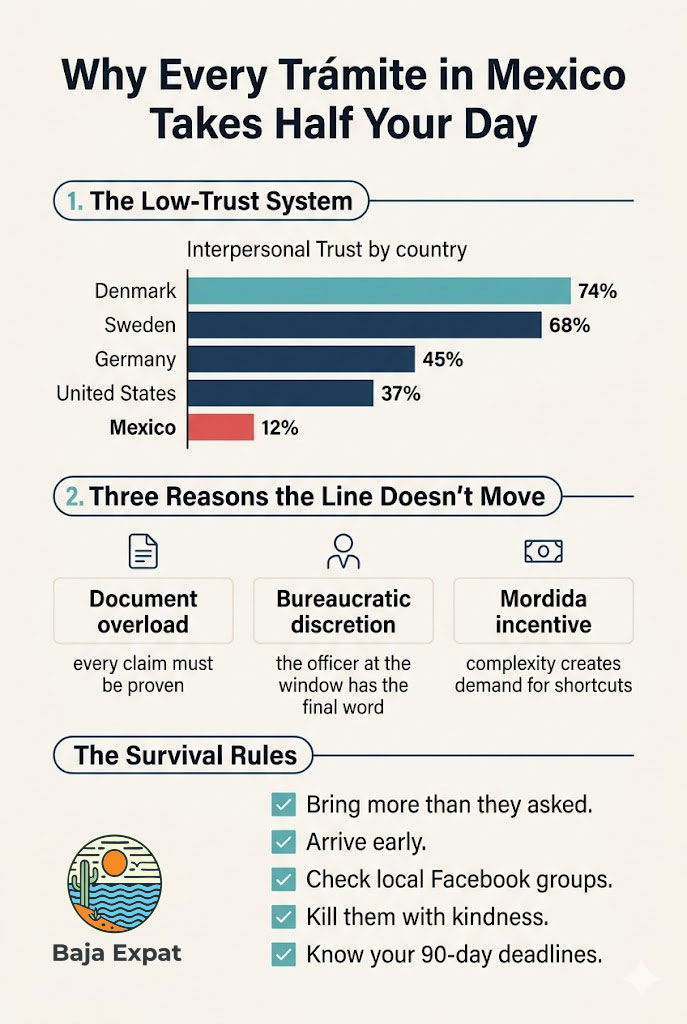
How to Survive the System
None of this is fair. All of it helps.
📄 Bring more than they asked for
The official requirements list is a minimum. Bring originals of everything plus two copies. Front/back of each ID on separate sheets unless told otherwise. If there's any doubt, print it.
📅 Arrive early, every time
Get there before the office opens if you don't have an appointment. If you do have one, arrive 30–60 minutes early and ask to have your documents reviewed before you're called. They may still send you home. At least you'll know sooner.
🔍 Check local Facebook groups first
INM offices have their own interpretations of the official rules. What Ensenada requires this month may differ from what was required last month. The expat groups have real-time intel on exactly which documents your specific office is currently demanding.
😊 Kill them with kindness
Smile. Say buenos días. Be polite in Spanish even if you can barely manage it. The officer has wide discretion on how long you wait, whether your documents pass, and where in the fine range you land. Make them feel respected. It won't guarantee anything. It improves the odds.
🧘 Don't react visibly
Sighing, eye-rolling, obvious frustration — even when completely justified — will be noticed and remembered. I know this firsthand. The officer who saw me roll my eyes processed my fine paperwork the following month. I got lucky that she was fair anyway. Don't count on that.
🗣️ Bring a Spanish speaker you trust
Having a native speaker — especially a Mexican national — as your translator changes the dynamic. They can read the room in ways you can't. They can soften things. Just make sure they're better at keeping a straight face than you are.
🚫 Don't pay mordidas
The shortcut feeds the machine. And for expats, paying a bribe to a government official carries real legal risk including deportation. If a gestor's fee seems suspiciously above the official rate, get clear on what you're actually paying for.
⏰ Know your 90-day deadlines
Changed your marital status? Moved? Changed jobs? You have 90 days to notify INM in person. Miss the window and you will be fined. The fine range is 20–100 UMA (~2,346–11,731 MXN in 2026). The officer decides where you land. Don't learn this the hard way.
One last thing worth naming. In Ensenada, Mexicans and Latin American migrants often get treated more warmly than white Americans at INM. You may wait longer. Your documents may get more scrutiny. Your mistakes may be treated less charitably. The Venezuelan man in the office the same day I got fined walked out with “no te preocupes.” That’s not a complaint, it’s just the reality on the ground. Adjust your expectations and your approach accordingly.
Sources
Share on
Bluesky Twitter Facebook LinkedInComments are configured with provider: disqus, but are disabled in non-production environments.